
For decades, coding followed a rigid formula: plan everything, write precise instructions, debug endlessly, repeat.
Then AI arrived—and quietly changed how we build.
Out of this shift emerged a new approach that many developers are practicing instinctively but few have formally named:
Vibe Coding.
Vibe coding isn’t about abandoning engineering discipline.
It’s about changing how ideas flow from the human mind into working software when AI is part of the process.
This article explains what vibe coding really is, how it differs from traditional coding and prompt engineering, when it works best, when it fails, and why it’s shaping the future of software creation.
What Is Vibe Coding?
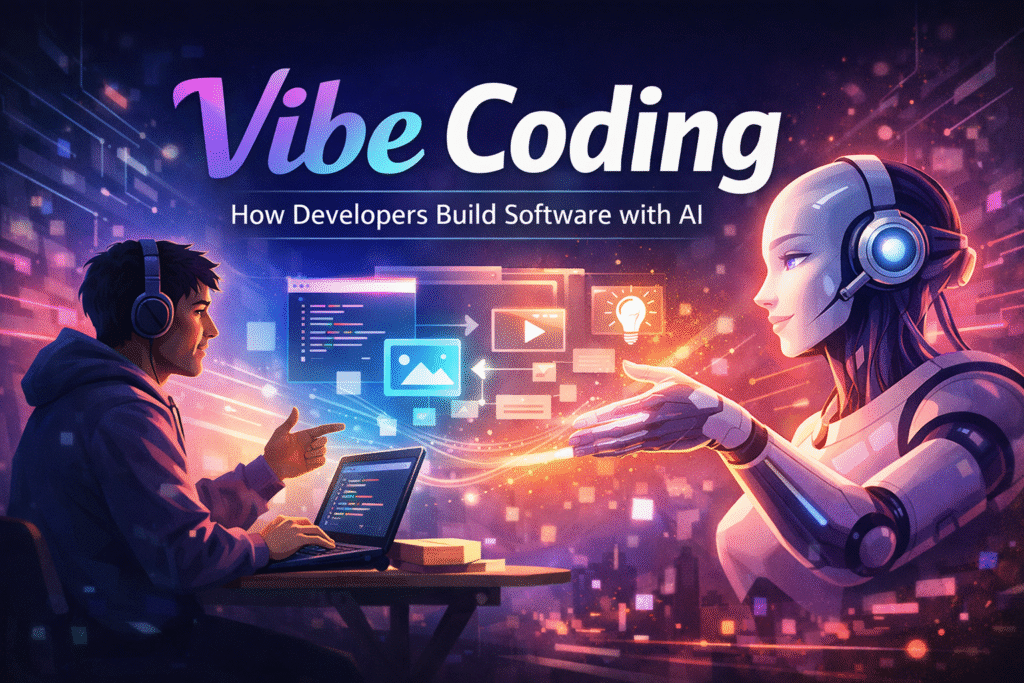
Vibe coding is a way of building software where the developer acts more like a creative director than a strict instruction writer.
Instead of:
- Writing exact logic upfront
- Fully planning architecture before starting
- Obsessing over correctness from the first line
You:
- Start with intent
- Communicate ideas conversationally
- Iterate rapidly with AI
- Adjust based on feel, clarity, and outcome
In vibe coding, you don’t just tell the AI what to do.
You collaborate with it.
Think of it as:
“I know what I want this to feel like—help me get there.”
Why Vibe Coding Exists Now (and Not Earlier)
Vibe coding only became possible because modern AI models can:
- Understand natural language intent
- Hold context across iterations
- Improve outputs based on qualitative feedback
- Translate vague ideas into structured code
Earlier programming languages required precision because machines couldn’t interpret ambiguity.
AI can.
That single shift unlocks an entirely new workflow.
Vibe Coding vs Traditional Coding
Traditional coding assumes:
- The human must think through everything first
- The computer executes exact instructions
- Errors are corrected manually
Vibe coding assumes:
- The human provides direction and judgment
- The AI fills in implementation details
- Refinement happens through conversation
Example difference
Traditional approach
- Design system
- Define architecture
- Write functions
- Test
- Debug
Vibe coding approach
- “I want a clean dashboard for tracking revenue”
- “This layout feels cluttered—simplify it”
- “Make it more premium”
- “Now optimize performance”
Both lead to working software—but the experience is completely different.
Vibe Coding vs Prompt Engineering (Important Distinction)
This is where most people get confused.
Prompt engineering
- Is about precision
- Focuses on structure, roles, constraints
- Optimized for repeatability and reliability
- Essential for production systems
Vibe coding
- Is about flow
- Uses informal, evolving prompts
- Optimized for creativity and speed
- Ideal for exploration and prototyping
Key insight:
Vibe coding often comes first.
Prompt engineering comes later to stabilize what vibe coding discovers.
They are not competitors.
They are phases of the same workflow.
The Core Principles of Vibe Coding
1. Intent Over Instructions
You start with what you want, not how to build it.
Instead of:
- “Create a React component with X props”
You say:
- “I want this to feel fast, clean, and trustworthy”
2. Iteration Over Perfection
First output doesn’t need to be correct—it needs to be close.
You refine by saying things like:
- “This feels too complex”
- “Make it calmer”
- “This copy sounds robotic”
- “Think more like a human user”
3. Taste Becomes a Skill
In vibe coding, your judgment matters more than syntax.
The developer’s role shifts from:
- Writing code → evaluating output
- Debugging logic → shaping direction
Good taste produces good software.
4. Speed Beats Formality (Initially)
Vibe coding optimizes for:
- Fast feedback loops
- Quick prototypes
- Early validation
Formality comes later—after the idea proves itself.
Where Vibe Coding Works Extremely Well
Vibe coding shines in areas where clarity emerges through iteration:
- UI/UX design
- Landing pages and copy
- MVPs and prototypes
- No-code / low-code apps
- Internal tools
- AI agents and workflows
- Creative coding projects
If the problem benefits from exploration, vibe coding is powerful.
Where Vibe Coding Fails (Be Honest)
Vibe coding is not magic.
It struggles when:
- Systems require strict guarantees
- Safety, compliance, or correctness is critical
- Outputs must be identical every time
- Large teams need standardized behavior
Examples:
- Financial systems
- Medical software
- Core infrastructure
- Regulated environments
In these cases, prompt engineering + traditional engineering discipline must dominate.
The Ideal Modern Workflow (Vibe → Structure → Scale)
The best builders today follow a three-stage flow:
Stage 1: Vibe Coding
- Explore ideas
- Shape UX
- Discover direction
- Move fast
Stage 2: Prompt Engineering
- Formalize prompts
- Add constraints
- Ensure consistency
- Reduce ambiguity
Stage 3: Engineering & Automation
- Version control
- Testing
- Deployment
- Scaling
Vibe coding is not the destination.
It’s the starting engine.
Why Vibe Coding Is a Superpower for Beginners
For newcomers, vibe coding removes:
- Syntax fear
- Tool overwhelm
- Early paralysis
Beginners can:
- Think in ideas
- Learn by seeing
- Improve by reacting
This dramatically shortens the learning curve.
Many people now build first and learn structure later—a complete reversal of the old model.
Why Experienced Developers Should Care
For experienced developers, vibe coding:
- Multiplies output speed
- Reduces mental load
- Allows focus on architecture and decisions
- Frees time from boilerplate work
It doesn’t replace expertise—it amplifies it.
Vibe Coding Is a Mindset Shift, Not a Tool
You don’t “install” vibe coding.
You adopt it when you:
- Stop over-explaining
- Start collaborating
- Treat AI as a creative partner
- Trust iteration more than upfront perfection
The future developer is not just a coder.
They are:
- A thinker
- A director
- A system designer
- A judge of quality
Final Thought: Why This Matters
Software creation is no longer limited by typing speed or syntax knowledge.
It’s limited by:
- Clarity of thought
- Strength of intent
- Quality of judgment
Vibe coding shifts the bottleneck from machines to human thinking.
And that’s a good thing.
Want to Build with This Approach?
At BuildWithHimank.com, we explore:
- AI-first building
- No-code + AI workflows
- Modern creator-developer skills
- Practical experiments, not theory
If you’re building in the age of AI, vibe coding isn’t optional.
It’s already happening.