
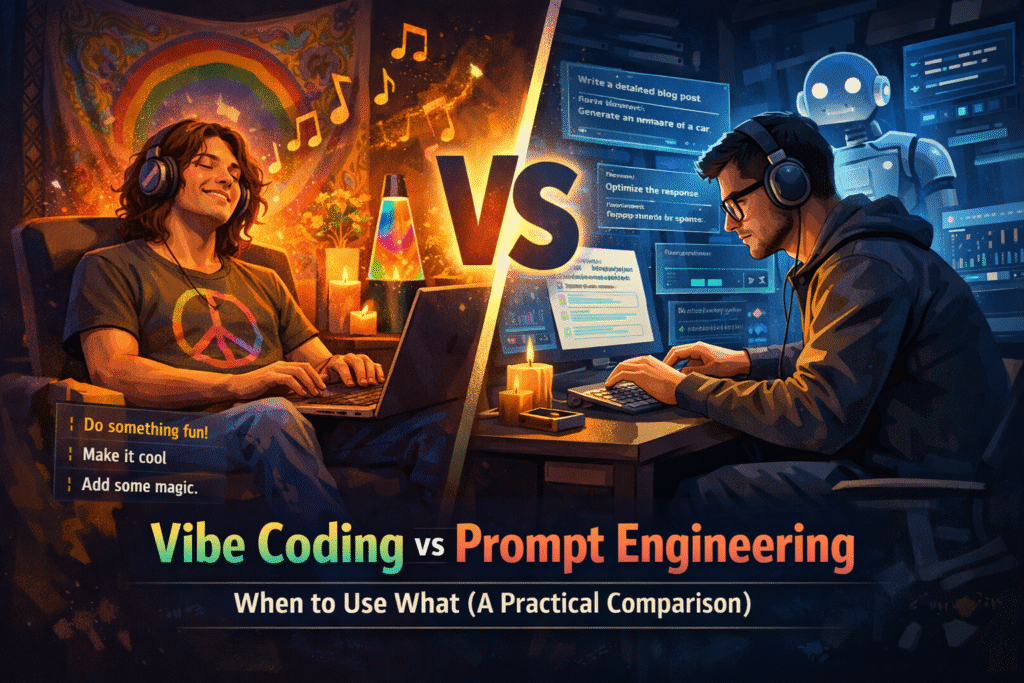
As AI becomes a core part of how software is built, two terms keep surfacing in developer and creator circles:
Vibe Coding and Prompt Engineering.
They are often confused.
Sometimes used interchangeably.
And frequently misunderstood.
This article brings clarity.
We’ll break down:
- What vibe coding really is
- What prompt engineering actually does
- How they differ in mindset and execution
- When to use each
- And how the best builders combine both
If you’re building with AI today, understanding this distinction is no longer optional.
First, the Short Answer
Vibe coding is about exploration and flow.
Prompt engineering is about precision and control.
They solve different problems at different stages of building.
What Is Vibe Coding? (Quick Recap)
Vibe coding is an AI-assisted development approach where the human focuses on intent, direction, and judgment, rather than strict instructions.
Instead of writing perfect prompts upfront, you:
- Start with an idea
- Talk to the AI conversationally
- Iterate based on feel and outcome
- Refine through feedback like
“this feels off”, “make it simpler”, “more polished”
The AI handles much of the implementation detail.
You guide the direction.
Vibe coding feels closer to creative collaboration than engineering.
What Is Prompt Engineering? (Proper Definition)
Prompt engineering is the practice of designing structured, precise prompts that reliably produce the desired output from an AI model.
It focuses on:
- Clear roles (“Act as a senior backend engineer”)
- Constraints (“Output only JSON”)
- Formats and rules
- Edge cases
- Repeatability
Prompt engineering treats AI like a deterministic system that must be controlled, not explored.
This is critical for:
- Production systems
- Automation
- Agents
- APIs
- Teams
Core Difference: Mindset
This is the most important distinction.
Vibe Coding Mindset
- “Let’s discover the right solution”
- Embraces ambiguity
- Values speed and creativity
- Direction emerges through iteration
Prompt Engineering Mindset
- “Let’s lock this down”
- Eliminates ambiguity
- Values consistency and reliability
- Direction is predefined
Neither is better.
They are optimized for different phases of work.
Vibe Coding vs Prompt Engineering (Side-by-Side)
| Aspect | Vibe Coding | Prompt Engineering |
|---|---|---|
| Primary goal | Exploration & creativity | Control & consistency |
| Prompt style | Conversational, evolving | Structured, fixed |
| Best stage | Early / discovery | Later / production |
| Error tolerance | High | Low |
| Repeatability | Not guaranteed | Strong |
| Ideal for | Prototypes, UX, ideas | Agents, automation, scale |
| Skill emphasis | Taste & judgment | Logic & structure |
When You Should Use Vibe Coding
Use vibe coding when:
1. You’re Exploring an Idea
You don’t fully know:
- What the UI should look like
- How the flow should feel
- What the best approach is
Vibe coding helps find the answer.
2. You’re Building an MVP or Prototype
Speed matters more than perfection.
You want:
- Something that works
- Something testable
- Something fast
Vibe coding removes friction.
3. You’re Working on UX, UI, or Content
Human feel matters more than correctness.
Examples:
- Landing pages
- Copywriting
- Design layouts
- User flows
Vibe coding shines here.
4. You’re a Beginner
Vibe coding lowers the barrier to entry.
Beginners can:
- Think in plain language
- Learn by seeing outcomes
- Improve through feedback instead of syntax memorization
When You Should Use Prompt Engineering
Use prompt engineering when:
1. You Need Consistent Outputs
If the same input must produce:
- Similar results
- Predictable structure
- Stable behavior
Prompt engineering is mandatory.
2. You’re Building AI Agents or Automation
Agents require:
- Strict rules
- Clear boundaries
- Controlled behavior
Vibe-based prompts will break here.
3. You’re Working in Teams
Teams need:
- Shared prompts
- Documentation
- Reproducibility
Prompt engineering enables collaboration.
4. You’re Shipping to Production
Production systems need:
- Reliability
- Safety
- Debuggability
Prompt engineering reduces risk.
The Best Builders Don’t Choose One — They Sequence Them
This is the part most articles miss.
High-performing AI builders don’t ask:
“Should I use vibe coding or prompt engineering?”
They ask:
“Which one should I use right now?”
A Modern AI-First Workflow
Step 1: Vibe Coding
- Explore
- Iterate
- Discover what works
- Shape intent
Step 2: Prompt Engineering
- Formalize what you discovered
- Add structure and constraints
- Remove ambiguity
Step 3: Engineering & Scale
- Automate
- Version
- Test
- Deploy
Vibe coding finds the path.
Prompt engineering paves it.
Common Mistakes to Avoid
❌ Using Vibe Coding in Production
This leads to:
- Inconsistent outputs
- Unpredictable behavior
- Debugging nightmares
❌ Starting With Heavy Prompt Engineering Too Early
This leads to:
- Overthinking
- Slower iteration
- Missed creative solutions
❌ Treating Them as Opposites
They are complementary, not rivals.
A Simple Rule of Thumb
If you’re still figuring things out → vibe code.
If you know exactly what you want → prompt engineer.
Why This Distinction Matters Long-Term
As AI becomes more capable, writing code will matter less than directing systems.
The future builder needs:
- Taste (vibe coding)
- Structure (prompt engineering)
- Judgment (knowing when to switch)
Those who master both will:
- Build faster
- Build better
- Build systems that scale
Final Thought
Vibe coding is how ideas are born.
Prompt engineering is how ideas survive in the real world.
If you’re serious about building with AI, you don’t pick sides.
You learn when to use what.
{ “@context”: “https://schema.org”, “@type”: “FAQPage”, “mainEntity”: [ { “@type”: “Question”, “name”: “What is vibe coding?”, “acceptedAnswer”: { “@type”: “Answer”, “text”: “Vibe coding is an AI-assisted development approach where developers focus on intent, creativity, and iteration rather than strict instructions. It relies on conversational interaction with AI to explore ideas and refine outputs.” } }, { “@type”: “Question”, “name”: “What is prompt engineering?”, “acceptedAnswer”: { “@type”: “Answer”, “text”: “Prompt engineering is the practice of writing structured, precise prompts to ensure consistent, reliable, and repeatable outputs from AI models, especially in production systems and automation.” } }, { “@type”: “Question”, “name”: “Is vibe coding better than prompt engineering?”, “acceptedAnswer”: { “@type”: “Answer”, “text”: “Neither is better. Vibe coding is ideal for exploration and early-stage building, while prompt engineering is essential for consistency, automation, and production-ready systems.” } }, { “@type”: “Question”, “name”: “When should I use vibe coding?”, “acceptedAnswer”: { “@type”: “Answer”, “text”: “Use vibe coding when you are exploring ideas, building prototypes, designing UX/UI, or when speed and creativity matter more than strict consistency.” } }, { “@type”: “Question”, “name”: “When should I use prompt engineering?”, “acceptedAnswer”: { “@type”: “Answer”, “text”: “Use prompt engineering when building AI agents, automation workflows, APIs, or production systems that require predictable, repeatable, and controlled outputs.” } }, { “@type”: “Question”, “name”: “Can vibe coding and prompt engineering be used together?”, “acceptedAnswer”: { “@type”: “Answer”, “text”: “Yes. Modern AI builders often start with vibe coding to discover the right solution and then apply prompt engineering to formalize and scale it reliably.” } } ] }